The CRE Outsourcing Calculation is Changing
CRE Services Intelligence, Issue #006

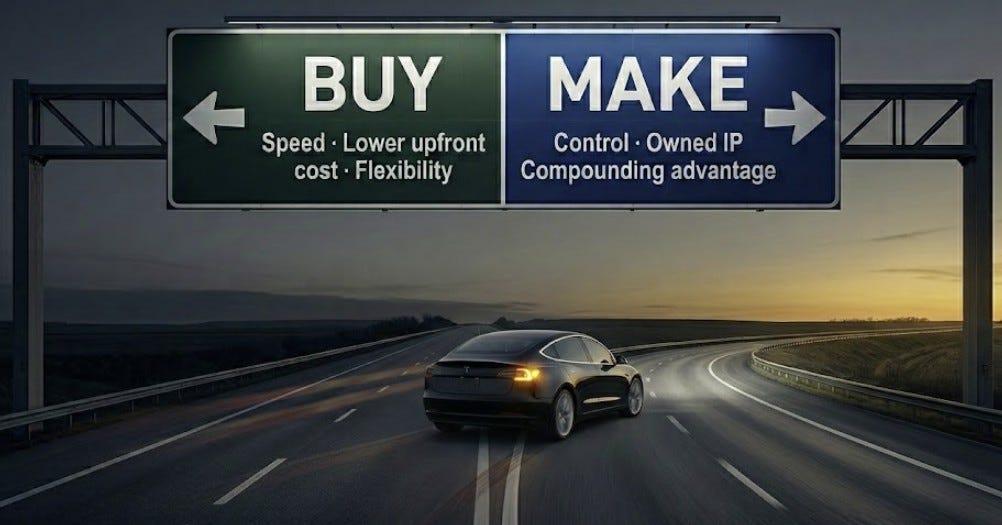
When AI enables competitors to replicate your service, and enables your clients to self-perform it, what’s your best defense strategy?
Is there a high margin line of your business that two people with AI could rebuild in 90 days?
In commercial real estate services, the answer for several service lines is increasingly yes. Lease abstraction, portfolio reporting, and market data aggregation are repeatable, information heavy, and built on workflows a very small team with current tooling can now rebuild a functional version of at a fraction of the historical cost and time. The picture is different for work that carries credentials and liability, regulated valuation sign off or complex capital markets advisory, where replication is far harder.
The competitor replicating your service is one source of that risk. The client deciding to perform it in house is the other, and the less discussed of the two. That second risk is not uniform. Large institutional owners are far better placed to self perform than mid market or fragmented ownership groups, so the pressure lands first and hardest at the top of the market.
The division of labour behind the industry
The CRE services industry rests on a division of labour. The client owns or leases the building, the space, the productive asset. The services firm provides the intelligence wrapped around it: valuation, analytics, management, and market view. For decades that division held because coordinating the work internally cost more than buying it from a specialist. The client concentrated on the asset and outsourced the information layer.
Two factors are now changing that calculation.
AI has reduced the cost of coordination and execution. Work that previously justified an internal department or a retained advisor can increasingly be handled by a small team running automated workflows. That shifts the exposure for a CRE services firm along two separate lines.
The first is competitive. A smaller, AI native firm can now deliver an informationally intensive service such as valuation support or portfolio analytics with far less labour, and price accordingly. This is a recognisable pattern, and most firms are already alert to it.
The second is structural. The same economics that let a competitor replicate a service also let the client perform it in house. The client already controls the asset, owned or leased. In many cases the client already holds the underlying data. The make versus buy decision that underpins the CRE outsourcing model is being recalculated, and for the informationally intensive service lines the calculation increasingly favours building.
The economics of integration are reversing
For forty years the strategic orthodoxy was to focus on the core and outsource the rest. Specialise, and buy everything else, because internal coordination cost more than it returned. AI changes that arithmetic. As coordination and execution costs fall, owning more of the stack becomes viable again, and integration that did not previously justify itself starts to.
Tesla is the clearest case, and the relevant detail for this sector is a property one. Gigafactory Nevada is, by Tesla’s own account, a 5.4 million square foot industrial facility built on a $6.2 billion investment, among the largest buildings in the world by footprint. It is exactly the kind of major industrial asset whose design and construction programme a developer or occupier would historically hand almost entirely to external CRE and construction advisers. Tesla took a different path. While it still used specialist contractors for much of the physical work, it acted as its own construction contractor on the programme, filing more than 20 building permits worth over $45 million in a single four month period and keeping project and cost coordination in house rather than appointing a managing agent. The point is not that Tesla eliminated the intermediary entirely. It is that the asset owner pulled the coordinating, decision making layer, the part a CRE project and cost management team would normally own, back inside its own walls. More broadly, Tesla attributes its advantage to vertical integration: tighter control, faster iteration, and lower cost than competitors carrying third party margins. It is now extending that into in house semiconductor fabrication. The hyperscalers show the same pattern, with Google, Amazon and Microsoft designing their own silicon and competing with the suppliers they once depended on.
The common thread is that an owner with the right tooling increasingly chooses to perform work it used to buy. That is precisely the position a CRE services client is now in.
This is not a technology industry curiosity. It is a direct preview of what happens to any sector where an intermediary sits between an owner and the intelligence about their own assets.
What it looks like in property
It is already happening in real estate, and the property version is sharper than the analogy.
Look at the vertically integrated residential operator. Firms like Greystar develop, own, and manage at scale, capturing the value chain across the asset lifecycle rather than outsourcing leasing and management to third parties. AI is making that integration easier to sustain. EliseAI reports that across its client base it automates around 90 percent of leasing conversations, handling over 1.5 million customer interactions a year and contributing to some $14 million in aggregate payroll savings. These are the vendor’s own figures, but the direction is clear, and the signal in its 2025 survey of 280 multifamily executives is sharper still: 78 percent reported they had already lost business to AI enabled competitors, and two thirds believed early adopters would hold a lasting advantage. The leasing and tenant communication function a landlord once handed to a brokerage can increasingly be run in house, with materially less headcount.
Look at the data spine. Cherre reports powering more than $3.3 trillion in assets under management for institutional investors, REITs and asset managers, providing a single source of truth that eliminates the competing databases scattered across most real estate enterprises. Clients include major institutional owners like Nuveen Real Estate and RXR. This is vertical integration at the data layer. Owners are building their own connected intelligence substrate rather than depending on their advisor’s analytics. Once an owner holds its own connected data, much of the advisor’s information advantage erodes.
The timing is worth noting. In The AI-First Real Estate Company (BCG, 2026), drawing on its Build for the Future survey, around 25 percent of real estate firms qualify as AI leaders against roughly 40 percent across all industries, and the sector invests close to half the cross industry average in AI, behind even other asset heavy sectors such as utilities. Read with care, that says the property sector is adopting later than most, which cuts two ways. It leaves room for early movers to establish an advantage, but it also means the self performance and integration shifts described here are still emerging rather than settled. The point is directional, not a prediction of timing.
The physical anchor changes the threat map
Here is what makes CRE different from law, accountancy or consulting, where the same AI pressures apply. In those industries the entire service is informational, so the whole thing is exposed. In property, the service sits on top of a physical asset that does not go away. Buildings still need managing, valuing, leasing, maintaining.
That physical anchor splits the service lines into two groups, and the split is one of the more useful strategic maps a firm can draw right now.
The physically anchored service lines are more insulated. Hard FM, engineering, construction and project delivery are rooted in physical work that cannot be wholly replicated by a small team with software. That insulation is partial and narrowing, remote monitoring, sensor based management and centralised operations are steadily reducing the on site component, but a physical residual remains.
The informationally exposed service lines are not insulated in the same way. Valuation, portfolio reporting, lease administration and market research are predominantly information work, which makes them the most straightforward for both a competitor to rebuild and a client to bring in house. Margins vary widely across these lines, and some of the most profitable parts of the business, capital markets advisory among them, are exposed less through their data workflows than through the relationships and judgement that surround them. The relevant question is not which line earns most, but how much of each line is pure information processing versus relationship and judgement.
If revenue is concentrated in the informationally exposed lines, the firm may be more exposed than its headline numbers suggest. The protection, where it exists, is not in the service itself. It is in what sits underneath it.
Five defences
What actually defends a margin when both competitors and clients can replicate the work? Five things, none of which is the service line itself.
1. Own connected data, not just data. Every CRE firm owns data. Almost none can reach it, because it sits siloed across Yardi, MRI, ARGUS, Qube, CoStar, spreadsheets and PDFs, fragmented by design and often by vendors who profit from the lock in. The firm that actually connects its data holds something neither a competitor nor a client can easily replicate, because the fragmentation that plagues everyone else is the moat. Connected proprietary data is one of the hardest assets to copy. The data has to be connected to count. Most firms own it and still cannot use it.
2. Build the faster learning loop. If your organisation improves how it does something every cycle, and the improvement compounds, you become extremely difficult to catch, by a competitor or a client. This is the deepest moat and the hardest to build, because it is architectural rather than a tool you buy. It is the difference between owning AI tools and running an AI native operation that gets better on its own.
3. Embed in the client’s transformation. Your client is going to go through this whether you help or not. If they insource and you played no part, you lose the account. If you help them become AI native, redesigning how they run their portfolio, their data, their operations, you stay essential and you move up the value chain from service provider to transformation partner. The firms that survive will be the ones whose clients cannot imagine doing it without them. The alternative is becoming the thing the client quietly replaces.
4. Disrupt your own service lines first. If a small team could rebuild a functional version of your most profitable line, be that team. Build the AI native version yourself, at the edge of your own business, before a competitor or a client does it to you. Fork one workflow, run it lean, let it prove itself alongside the legacy operation. This is not a new idea. It is why Nestlé built Nespresso outside the mothership and why AWS was never going to be built inside Amazon’s retail core. Disruptive things happen at the edge. What is new is that AI has made the edge cheap enough for anyone to build from, including you. Do it, and the disruptive build stops being a threat and becomes the moat. You capture the efficiency, you keep the data, you keep the client.
5. Defend the judgement and relationship layer. When execution is nearly free, judgement and taste become more valuable, not less. The curatorial call, the experienced read of a situation, the trusted relationship that makes a client stay, these are the things AI reinforces rather than replaces. Brand and relationship are the final defence, and in a world where anyone can run the workflow, they may be the most durable one.
The implication
The CRE services firm is not responding to a single competitor. It is responding to a change in the economics that created the industry. The client owns or leases the asset. For decades the services firm owned the intelligence around it. AI is narrowing the cost gap that kept those two things separate.
On current evidence, the firms best positioned are not the ones with the strongest individual service lines, since those are the most replicable assets they hold. They are the ones building connected proprietary data, a compounding learning loop, deep involvement in their clients’ own transformation, and an AI native version of their highest value workflows before a competitor or client builds it first.
The closing question is a practical one. If a small team could rebuild a functional version of your most valuable service line from current tooling, the relevant decision is whether you build that version yourself, on your own data and inside your own client relationships, before someone else does.
CRE Services Intelligence tracks Revenue Per Employee across the Big Four as a proxy for platform maturity and operational efficiency. The 5+1 layer Property OS framework is original to BDE Consulting Ltd. Vertical integration and vendor landscape research compiled May 2026; company metrics reflect publicly disclosed or company-reported figures.
Sources: BCG, The AI-First Real Estate Company (2026) and Build for the Future survey; EliseAI client data and 2025 State of AI in Multifamily survey; Cherre company disclosures; Tesla company disclosures and contemporaneous construction reporting on Gigafactory Nevada.
© BDE Consulting Ltd, June 2026